Saturday, 29 March 2014

Frog Pond Fills

Frog pond in the making
Cumulative rainfall of more than 140mm from March 25 to 28, 2014 produced enough runoff at Peacehaven Park to fill the recently built frogpond. TRC staff Wayne and Dan'l handpicked suitable stones and rocks from a rural site then painstakingly sorted and set them to create an attractive and frog-friendly lining. As you can see the pond is full. Subsequent heavy rain on Sunday March 30 should have tested the bywash design.     Now all we need are some                                                                                            plants and frogs for a raucous                                                                                           chorus.
Filled Frog Pond 27-3-14

Monday, 27 January 2014

Ants Abound

Ants exploring Peacehaven
Have you seen the army of massive ants along the new rainforest path? If not they're worth a visit. We're told by Robert Campbell, Toowoomba Regional Council Parks and Gardens, that these aren't anything compared to some expected a little later this year. Keep your eyes open.
What a whopper! 
Can you see the little honey bee on the ant's abdomen?
Click the image to enlarge in a separate window.

Wednesday, 4 December 2013

Stinking out the place

Adults and at least three instars of
Lychee Stink Bug, 
Lyramorpha rosea. 
These little beasties were found on the Small-leaved Tuckeroo Cupaniopsis parvifolia last week. They are all the same species, Lychee Stink Bug, Lyramorpha rosea. The adults are obviously the larger, less-colourful ones. However underneath they are a beautiful apple green as you can partially see on a couple of them. 
sp
The smaller ones are three different stages or instars of the bug. (An instar is a developmental stage between each molt until sexual maturity is reached.) These little fellows are quite attractive in their orange and blue uniform.
sp
It is found on trees, as shown by the photograph, but also on the ground. There are lots of them on the trunk, branches and leaves of our Tuckaroo. They are sap suckers and leafeaters. There didn't seem much damage to the Tuckeroo. We'll have to keep an eye on it. Another species they like, Red Ash or Soap Tree Alphitonia excelsa has been badly attacked by something. Perhaps it is the stink bugs. They also like Leopard Ash Flindersia collina, and as its name suggests, lychees. It seems they are not a real problem in commercial orchards.
sp
An interesting fact about Shield or Stink Bugs is that the adults take care of their young. In the case of Lychee Stink Bug older instars help as well. No wonder they are so plentiful.
Older instars guarding younger ones.

Saturday, 16 November 2013

Such a darling

Queensland Darling Pea, Swainsona queenslandica flowering in September
Isn't this a stunning little darling? It was flowering beautifully in the Dry Rainforest Area of the Park in September. It was only planted in February so it is still quite small. Now its seed pods are decorating the little vine. This is the red flowering form. You may have seen the pink form in your garden. To find out more about this little plant go to Pretty Pink Darling Peas on member Trish Gardener's "Toowoomba Plants" blog.
Queensland Darling Pea, Swainsona queenslandica. Just a small plant in the mulch
The decorative seed pods

Thursday, 12 September 2013

Community Tree Planting — 9 am, 5 October 2013

Members of the Friends at one of our earlier planting days.
Come along and plant a tree!

Members of the public will have the opportunity to actively contribute to the revival and improvement of Peacehaven in October. 

On Saturday, 5 October, Toowoomba Landcare Group, together with the Friends of Peacehaven Botanic Park and Toowoomba Regional Council will host a community tree planting day in Peacehaven Botanic Park.

In an area of existing, large eucalyptus trees, about 200 native shrubs and ground story plants will be established. This will result in a pocket of bush representing the layered vegetation of a native dry sclerophyll forest that once dominated our local landscape.

Everybody is welcome from 9am to help with planting. All tools and gloves will be supplied and volunteers can enjoy a free sausage sizzle after the activity.

Our community nursery will be open and it will also be an opportunity to take a walk through the park to see recent developments.

(For those who’ve always wondered sclerophyll is derived from the Greek sklēros hard  and phullon a leaf. Sclerophyllous plants are prominent throughout Australia, the Mediterranean Basin, Californian woodlands, Chilean Matorral, and the Cape Province of South Africa.)


Wednesday, 4 September 2013

200 Years of History

When Mayor Paul Antonio unveiled the ‘Stump in Time’, 200 years of history went on show. Despite the downpour right at the time of the occasion more than 50 Friends and members of the community made the morning a success.
Toowoomba Mayor Paul Antonio (right) and President of the Friends, George Smith,
with the 'Stump'. 
George, President of the Friends, made particular mention of Anna Smith “who had the original concept of the Stump in Time.  Anna is a former secretary and has been a tireless worker in many activities for the Friends.”
The "Stump" is a giant ancient Blackbutt and it demonstrates through its growth rings how Highfields has developed over the last two centuries. Information signs display landmark local and worldwide events in that time. Mosaics created by Anglicare volunteers illustrate some of Highfields history.
The Anglicare group who designed and created the mosaics.
The Friends have spent 2 years planning  this project. Preparing the stump, the design and installation of the signs and mosaics were possible with a grant from the Gambling Community Benefit Fund, Anglicare and the support of the Toowoomba Regional Council.
The growth rings in the Blackbutt stump.
The mature native trees at Peacehaven make it a special place. Stan Kuhl saw the value of these magnificent giants and donated the land to the community for centuries to come. 

Saturday, 1 June 2013

Changes at Davidson

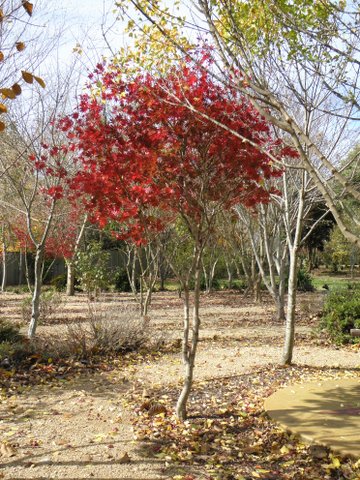
Autumn is always the most spectacular time at Davidson Arboretum. As these photos taken this blustery, grey morning plainly show.


Deciduous trees behind the Rotary shelter


The leaves have turned to their autumn colour but there are also other changes afoot. Parks and Gardens staff of the Toowoomba Regional Council have been working hard in the Arboretum.

Camellias along the fence.
First, there are new plantings including deciduous trees, camellias, clivias and annuals. 


Replacement planting
Clivias


Annuals


Chinese Celtis


A Chinese Celtis, Celtis sinensis, will grow into a magnificent tree, but it becomes an invasive weed in Toowoomba. It is possible this one in Davidson grew from a seed dropped by a bird. The King Parrots and Pale-headed Rosellas love the fruit of this species.

Just see this young Celtis outstripping the delicate maple, and many more seedlings are springing up.


The above stumps tell their own story. Trees that have grown just too close. 

Below, three giant pines were removed from here to open up a space too heavily shaded. Other trees around them were already straining to grow away from them. Specimens underneath were becoming weak and misshapen.


The Pinetum at Davidson Arboretum


The remaining pines include some really interesting ones and it is planned that young of these will be grown and planted in Frenau Pines Pinetum on Hursley Road. Here they will have more room to develop than the tiny hectare of the Arboretum. 

Ken Davidson planted rare, interesting and/or exotic trees, especially deciduous temperate trees that colour in the autumn, and this vision will live on.

Lastly, two little nature notes which occurred while I was at Davidson this morning.
This White Migrant butterfly looks just like the leaves it is resting on.
An immature Golden Whistler. This is very similar to a female Golden Whistler
but has the rufous margins to its wing feathers. Note the yellow under the tail.

Thursday, 25 April 2013

Autumn Sunshine

This petite beauty was found shading itself from the midday sun today. It is the Eastern Dwarf Tree Frog, Litoria fallax. The leaf of the Pandora pandorana cv. "Ruby Belle" was found to be the perfect sunshade. It also shows how small this little amphibian is. 
Eastern Dwarf Tree Frog, Litoria fallax
Common in the Highfields district, you'll often hear it calling from rank vegetation. At Peacehaven listen out beside the wildlife area near the Old Dairy. One field guide describes its call as a 'ratchet-like "Reek...pip. Reek---pip...pip".' 

Tuesday, 9 April 2013

Backyard Birds of the Toowoomba Region Workshop

WHEN: 18 May 2013 

WHERE: In the State Emergency Headquarters, K Block, 165 Hume St, Toowoomba


Program:
10 am:
   
 1. Opening by Mayor, Paul Antonio
    2. The National Birds in Backyard Program (Holly Parsons, Birds in Backyards Program 
          Manager)
    3. Suitable plants to attract birds (Patricia Gardner, Toowoomba Field Naturalists Club)
    4. Cultivated plants suitable/available for Toowoomba gardens (Lauren Marlatt, Toowoomba SGAP)
    5. How to identify birds (Mick Atzeni, Toowoomba Bird Observers Club)
    6. Using Bird Finder program and reporting birds to BIBY web site online (Grahame Rogers, BirdLife Southern Queensland)

12 noon:
    Lunch

1 pm – 4 pm:  
    Field trip to bird-friendly gardens (inner city, large block on urban fringe of the 
       Toowoomba Field Naturalist Club members ).

Cost $5 (to be paid on arrival).


RSVP essential to Grahame Rogers gwrogers[at]bigpond.com or 07 4698 1727 (Please replace 'at' with the symbol.)


Wednesday, 27 February 2013

Overlooked and Underrated

Smyrell's Clausena at Peacehaven
The Clausena smyrelliana, Smyrell’s Clausena or Greg’s Wampi (a great name in my opinion) was overlooked by Europeans until the 1990s. It was brought to the botanical world’s attention by Greg Smyrell, a Queensland botanist. They have been found in the rainforest only in a very restricted part of the Maryborough/ Bundaberg region. The first one was discovered by Greg Smyrell in the Hervey Bay area, then a few more in 2005 in a small patch at Mon Repos. Unfortunately the Bundaberg trees died, possibly due to the drought, and now only one, the original, is known to exist in the wild.


Why aren’t we shouting this from the rooftops? It must be one of the rarest plants in the wild. 

The flower with my finger tip to show the scale.
Luckily it has been easy to cultivate, and Peacehaven has its own beautiful specimen. It belongs to the Rutaceae or citrus family. The edible fruit is said to have a citrus flavour and the crushed leaves smell of lemon.

It’s a fast growing but small tree, about 7-8 m in the wild, probably smaller in your garden. It has a dense canopy of shiny, dark green leaves giving a very textural appearance. The flowers are tiny though showy in clusters above the leaves. The fruit when ripe are white.

A close cousin is the Clausena lansium or Wampi from Asia. Its fruit is very sweet and popular in that part of the world fresh or cooked in pies or jams.  
Unripe fruit of Clausena smyrelliana