Showing posts with label Butterflies. Show all posts

Saturday, 1 June 2013

Changes at Davidson

Autumn is always the most spectacular time at Davidson Arboretum. As these photos taken this blustery, grey morning plainly show.

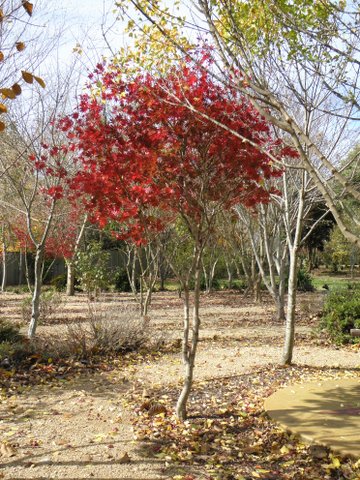


Deciduous trees behind the Rotary shelter


The leaves have turned to their autumn colour but there are also other changes afoot. Parks and Gardens staff of the Toowoomba Regional Council have been working hard in the Arboretum.

Camellias along the fence.
First, there are new plantings including deciduous trees, camellias, clivias and annuals. 


Replacement planting
Clivias


Annuals


Chinese Celtis


A Chinese Celtis, Celtis sinensis, will grow into a magnificent tree, but it becomes an invasive weed in Toowoomba. It is possible this one in Davidson grew from a seed dropped by a bird. The King Parrots and Pale-headed Rosellas love the fruit of this species.

Just see this young Celtis outstripping the delicate maple, and many more seedlings are springing up.


The above stumps tell their own story. Trees that have grown just too close. 

Below, three giant pines were removed from here to open up a space too heavily shaded. Other trees around them were already straining to grow away from them. Specimens underneath were becoming weak and misshapen.


The Pinetum at Davidson Arboretum


The remaining pines include some really interesting ones and it is planned that young of these will be grown and planted in Frenau Pines Pinetum on Hursley Road. Here they will have more room to develop than the tiny hectare of the Arboretum. 

Ken Davidson planted rare, interesting and/or exotic trees, especially deciduous temperate trees that colour in the autumn, and this vision will live on.

Lastly, two little nature notes which occurred while I was at Davidson this morning.
This White Migrant butterfly looks just like the leaves it is resting on.
An immature Golden Whistler. This is very similar to a female Golden Whistler
but has the rufous margins to its wing feathers. Note the yellow under the tail.

Thursday, 6 December 2012

Hidden Delights

Wandering around Peacehaven recently, I was fascinated with the secret wonders along the way.
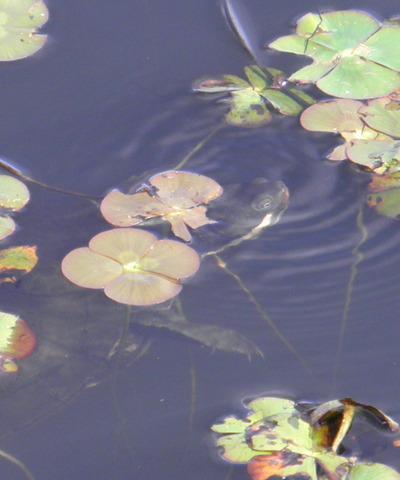
A turtle snout peeping through the Nardoo.
At the dam the turtles were hiding under the Common Nardoo, Marsilea drummondii. They are probably the Eastern Long-necked Turtle, Chelodina longicollis. When you walk onto the jetty you are likely to see a few sticking their nostrils out of the water. The dam is perfect for them as there are safe sunbathing sites and plenty of food. They eat insects, worms, tadpoles and small frogs. 
Christmas beetle, Anoplognathus pallidicollis
In the wildlife garden beyond the rainforest I found this Christmas Beetle. They are not always well-liked by gardeners as they can defoliate vegetation if there are large numbers of them. A member of the scarab family, this golden beauty always reminds me of my childhood.

In the rainforest area is this little delight. You can see how tiny the flowers are by my fingers. The flowers are followed by lovely white berries later in summer. The shrub has luxuriant glossy leaves and loves semi-shade. 
Flowers of Smooth Psychotria,
Psychotria daphnoides
Smooth Psychotria,
Psychotria daphnoides
Another hidden treasure in the rainforest was the Common Brown Butterfly, Heteronympha merope, resting in the dappled foliage. Click here for more on this interesting butterfly. It is difficult to find with its colour and shape such good camouflage.

Fern frond catching the early morning sun.
In the heavy shade of the rainforest floor a ray of sunshine spotlighted a fern frond. It is difficult to believe this area was only planted 6-7 years ago. Already it has some of the characteristics of a much older forest.

The trees in the Brachychiton garden have been flowering for a while now over near the Scott St entrance. These include the Flame Tree, Lacebark, Kurrajong and the delicate cultivar "Gabby's Bells". Look carefully amongst the Flame Tree foliage and you'll find these seed pods. Hidden inside are the seeds ready to burst out. 
Brachychiton cv. “Gabby’s Bells”
 
Flame Tree, Brachychiton acerifolius

Tuesday, 7 February 2012

Pretty as a picture

Female Joseph's Coat Moth, Agarista Agricol, possibly laying eggs. 
(Photo P.Gardner)
Have you seen these flying around at the moment? Although seen during the day and are brightly coloured they are not butterflies, but moths. The Joseph's Coat Moth, Agarista Agricol, male and female are very similar though the female has a larger creamy-white bar across the thorax and running into the forewings as illustrated here. 

These links give more information on the Joseph’s Coat Moth,  http://lepidoptera.butterflyhouse.com.au/agar/agricol.html,   http://www.brisbaneinsects.com/brisbane_noctuidae/JosephsCoatMoth.htm. The caterpillar is amazingly attractive too, with black, white and orange stripes.

The moth larva or caterpillar feeds on Australian Native Grape, Clematicissus opaca, (also known as Small-leaved Water Vine, Forest Grape, Wappo Wappo, and Pepper Vine), and Slender Grape, Cayratia clematidea, (aka Native Grape, Bushy Water Vine, Slender Water Vine, Mor-bir). Both have inconspicuous creamy-white flowers, but dark blue-black fruit which also attract birds. 

Both vines would be an added attraction to a wildlife garden. The Clematicissus opaca is a dry rainforest vine and grows at Gowrie Junction so is most likely suitable for gardens west of Highfields. It is moderately frost hardy, drought hardy and likes full or part sun. Whereas the Cayratia clematidea is found in moist and dry rainforest, and vine thickets and probably more suitable for gardens closer to the range. It resists light frosts, is drought hardy and thrives in full or part sun.

Both are supposedly bush tucker plants and more can be read about them here, http://tasteaustralia.biz/bushfood/bush-tucker-garden/, but be very cautious eating anything you find in the bush. Also this link has more about ‘native grapes’ and bush tucker, http://toowoombaplants2008.blogspot.com.au/2010/05/round-leaf-vine.html


Friday, 21 October 2011

Crows Ash

The Crows Ash Flindersia australia is one of the Park's iconic trees. It is a wonderful specimen that stands alone in the south-west section of the park.

The Crows Ash in Peacehaven Botanic Park

It gives a wonderful amount of shade and is an ideal tree for a large block. However it takes some time for it to grow as large as the one in Peacehaven which is estimated to be about 150 - 200 years old.
The Park's botanic logo is based on the lovely capsule. 
Crows Ash capsule


It is also a host plant for the beautiful Orchard Swallowtail Papilio aegeus caterpillar.
 
Orchard Swallowtail larva

Male Orchard Swallowtail

Sunday, 25 September 2011

Native Plumbago

The Native Plumbago, Plumbago zeylanica, is flowering in the Dry Rainforest section of the park after being hit hard this winter. This delightful little plant is very similar to the plumbago we grow in our gardens, the introduced Plumbago auriculataLike many exotic species the South African plumbago can become a nuisance with its the spreading suckers. 

Plumbago zeylanica
The Australian plumbago has a lower, less invasive growing habit. In the wild it will grow in dappled to fairly heavy shade, so is good for a ground cover around shrubs and trees in your garden.
For those who like to attract butterflies to their garden the Native Plumbago has other advantages. It is a host plant for our little Plumbago Blue Butterfly. The flowers are the food  for the larvae (caterpillars), and many butterflies are attracted to their nectar.
Plumbago Blue Butterfly, 
Leptotes plinius
The caterpillars of the Plumbago Blue are very cryptic and difficult to find, but the butterflies are usually fluttering around any plumbago plant. The male butterfly has a bluish sheen which is usually only seen when flying. The female has a slight wash of blue but more distinctive brown and white markings which may be the cause for their other name, Zebra Blue. The beauty of this butterfly is their underwings, as you can see by the picture taken in a Toowoomba garden. (Remember to right click on the image if you want to see an enlargement in a separate tab.)

If you want to know more about either the plant or the butterfly, please click on either of these links: