Showing posts with label Wildlife. Show all posts

Saturday, 29 March 2014

Frog Pond Fills

Frog pond in the making
Cumulative rainfall of more than 140mm from March 25 to 28, 2014 produced enough runoff at Peacehaven Park to fill the recently built frogpond. TRC staff Wayne and Dan'l handpicked suitable stones and rocks from a rural site then painstakingly sorted and set them to create an attractive and frog-friendly lining. As you can see the pond is full. Subsequent heavy rain on Sunday March 30 should have tested the bywash design.     Now all we need are some                                                                                            plants and frogs for a raucous                                                                                           chorus.
Filled Frog Pond 27-3-14

Saturday, 9 February 2013

Blood in the Park

You can’t hear yourself think at Peacehaven at the moment. The lorikeets, all three resident species, are screaming their heads off in the tall timbers. It’s enough to make your blood boil, or have their blood on your hands.
Red Bloodwood, Corymbia gummifera

However that’s not the kind of blood I’m really referring to but the Red Bloodwoods which are flowering profusely at the moment. Corymbia gummifera (once known as Eucalyptus gummifera) make up part of Peacehaven’s mature tree collection and with their summer blossom are causing hysteria in the lorikeet communities.

The Red Bloodwoods are at, or close to, their maturity as they typically grow to approximately 20-30 metres and the ones in the Park are about that height. They are full of flowers and buds at the moment and as the flowers are on the edge of the canopy the creamy mass is very showy.
The showy flowers
Corymbia gummifera flower
As befitting a tree of this magnificence the gumnuts or seed capsules are stylish too. They are urn-shaped and about 1 cm wide. 
Corymbia gummifera seed capsule 

Lorikeets are only one of the nectarivores that love the bloodwood. In the wild honeyeaters, flying foxes, gliders, blossom bats, and diurnal and nocturnal insects also feed on the nectar; while Sugar Gliders eat the sap. It is thought that birds and flying foxes carry the pollen far afield ensuring there is cross pollination. Once the seeds ripen the cockatoos will come into feed so the screaming isn't over yet.
The characteristic red gum staining the bark
The bloodwoods are named because of the sap or kino that seeps from wounds on the tree. This can be a brilliant red in some specimens. Our trees don’t show much of this but a couple of branches that came down in the recent high wind are scarred red.

The timber is a deep red colour and termite resistant so is used for rough construction purposes such as fencing, power poles, house stumps, mining timbers and railway sleepers.

The aborigines used the sap to stop fraying on their fishing lines, and both the sap and the leaves had medicinal qualities particularly for open sores. 
Corymb structure of the floral clusters

Corymbia; from the Latin ‘corymbium’, referring to the branched structure of the terminal floral clusters called a corymb.
gummifera; from the Latin, referring to the gum production that is characteristic of this species.

Thursday, 6 December 2012

Hidden Delights

Wandering around Peacehaven recently, I was fascinated with the secret wonders along the way.
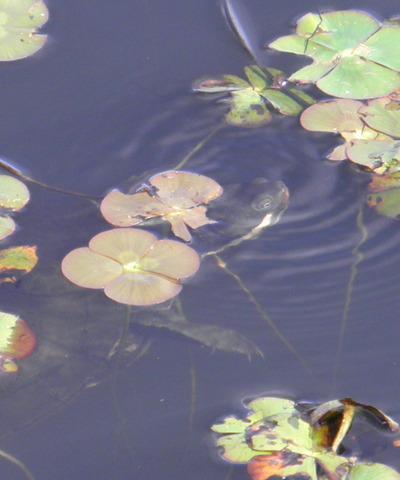
A turtle snout peeping through the Nardoo.
At the dam the turtles were hiding under the Common Nardoo, Marsilea drummondii. They are probably the Eastern Long-necked Turtle, Chelodina longicollis. When you walk onto the jetty you are likely to see a few sticking their nostrils out of the water. The dam is perfect for them as there are safe sunbathing sites and plenty of food. They eat insects, worms, tadpoles and small frogs. 
Christmas beetle, Anoplognathus pallidicollis
In the wildlife garden beyond the rainforest I found this Christmas Beetle. They are not always well-liked by gardeners as they can defoliate vegetation if there are large numbers of them. A member of the scarab family, this golden beauty always reminds me of my childhood.

In the rainforest area is this little delight. You can see how tiny the flowers are by my fingers. The flowers are followed by lovely white berries later in summer. The shrub has luxuriant glossy leaves and loves semi-shade. 
Flowers of Smooth Psychotria,
Psychotria daphnoides
Smooth Psychotria,
Psychotria daphnoides
Another hidden treasure in the rainforest was the Common Brown Butterfly, Heteronympha merope, resting in the dappled foliage. Click here for more on this interesting butterfly. It is difficult to find with its colour and shape such good camouflage.

Fern frond catching the early morning sun.
In the heavy shade of the rainforest floor a ray of sunshine spotlighted a fern frond. It is difficult to believe this area was only planted 6-7 years ago. Already it has some of the characteristics of a much older forest.

The trees in the Brachychiton garden have been flowering for a while now over near the Scott St entrance. These include the Flame Tree, Lacebark, Kurrajong and the delicate cultivar "Gabby's Bells". Look carefully amongst the Flame Tree foliage and you'll find these seed pods. Hidden inside are the seeds ready to burst out. 
Brachychiton cv. “Gabby’s Bells”
 
Flame Tree, Brachychiton acerifolius