Wednesday, 4 September 2013

200 Years of History

When Mayor Paul Antonio unveiled the ‘Stump in Time’, 200 years of history went on show. Despite the downpour right at the time of the occasion more than 50 Friends and members of the community made the morning a success.
Toowoomba Mayor Paul Antonio (right) and President of the Friends, George Smith,
with the 'Stump'. 
George, President of the Friends, made particular mention of Anna Smith “who had the original concept of the Stump in Time.  Anna is a former secretary and has been a tireless worker in many activities for the Friends.”
The "Stump" is a giant ancient Blackbutt and it demonstrates through its growth rings how Highfields has developed over the last two centuries. Information signs display landmark local and worldwide events in that time. Mosaics created by Anglicare volunteers illustrate some of Highfields history.
The Anglicare group who designed and created the mosaics.
The Friends have spent 2 years planning  this project. Preparing the stump, the design and installation of the signs and mosaics were possible with a grant from the Gambling Community Benefit Fund, Anglicare and the support of the Toowoomba Regional Council.
The growth rings in the Blackbutt stump.
The mature native trees at Peacehaven make it a special place. Stan Kuhl saw the value of these magnificent giants and donated the land to the community for centuries to come. 

Saturday, 1 June 2013

Changes at Davidson

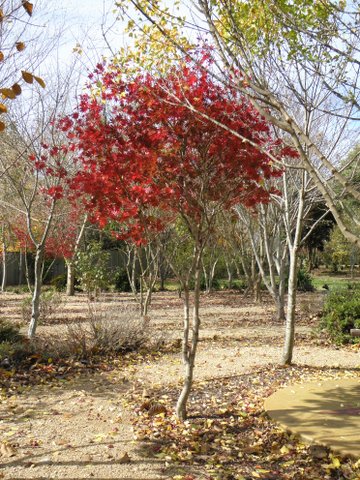
Autumn is always the most spectacular time at Davidson Arboretum. As these photos taken this blustery, grey morning plainly show.


Deciduous trees behind the Rotary shelter


The leaves have turned to their autumn colour but there are also other changes afoot. Parks and Gardens staff of the Toowoomba Regional Council have been working hard in the Arboretum.

Camellias along the fence.
First, there are new plantings including deciduous trees, camellias, clivias and annuals. 


Replacement planting
Clivias


Annuals


Chinese Celtis


A Chinese Celtis, Celtis sinensis, will grow into a magnificent tree, but it becomes an invasive weed in Toowoomba. It is possible this one in Davidson grew from a seed dropped by a bird. The King Parrots and Pale-headed Rosellas love the fruit of this species.

Just see this young Celtis outstripping the delicate maple, and many more seedlings are springing up.


The above stumps tell their own story. Trees that have grown just too close. 

Below, three giant pines were removed from here to open up a space too heavily shaded. Other trees around them were already straining to grow away from them. Specimens underneath were becoming weak and misshapen.


The Pinetum at Davidson Arboretum


The remaining pines include some really interesting ones and it is planned that young of these will be grown and planted in Frenau Pines Pinetum on Hursley Road. Here they will have more room to develop than the tiny hectare of the Arboretum. 

Ken Davidson planted rare, interesting and/or exotic trees, especially deciduous temperate trees that colour in the autumn, and this vision will live on.

Lastly, two little nature notes which occurred while I was at Davidson this morning.
This White Migrant butterfly looks just like the leaves it is resting on.
An immature Golden Whistler. This is very similar to a female Golden Whistler
but has the rufous margins to its wing feathers. Note the yellow under the tail.

Thursday, 25 April 2013

Autumn Sunshine

This petite beauty was found shading itself from the midday sun today. It is the Eastern Dwarf Tree Frog, Litoria fallax. The leaf of the Pandora pandorana cv. "Ruby Belle" was found to be the perfect sunshade. It also shows how small this little amphibian is. 
Eastern Dwarf Tree Frog, Litoria fallax
Common in the Highfields district, you'll often hear it calling from rank vegetation. At Peacehaven listen out beside the wildlife area near the Old Dairy. One field guide describes its call as a 'ratchet-like "Reek...pip. Reek---pip...pip".' 

Tuesday, 9 April 2013

Backyard Birds of the Toowoomba Region Workshop

WHEN: 18 May 2013 

WHERE: In the State Emergency Headquarters, K Block, 165 Hume St, Toowoomba


Program:
10 am:
   
 1. Opening by Mayor, Paul Antonio
    2. The National Birds in Backyard Program (Holly Parsons, Birds in Backyards Program 
          Manager)
    3. Suitable plants to attract birds (Patricia Gardner, Toowoomba Field Naturalists Club)
    4. Cultivated plants suitable/available for Toowoomba gardens (Lauren Marlatt, Toowoomba SGAP)
    5. How to identify birds (Mick Atzeni, Toowoomba Bird Observers Club)
    6. Using Bird Finder program and reporting birds to BIBY web site online (Grahame Rogers, BirdLife Southern Queensland)

12 noon:
    Lunch

1 pm – 4 pm:  
    Field trip to bird-friendly gardens (inner city, large block on urban fringe of the 
       Toowoomba Field Naturalist Club members ).

Cost $5 (to be paid on arrival).


RSVP essential to Grahame Rogers gwrogers[at]bigpond.com or 07 4698 1727 (Please replace 'at' with the symbol.)


Wednesday, 27 February 2013

Overlooked and Underrated

Smyrell's Clausena at Peacehaven
The Clausena smyrelliana, Smyrell’s Clausena or Greg’s Wampi (a great name in my opinion) was overlooked by Europeans until the 1990s. It was brought to the botanical world’s attention by Greg Smyrell, a Queensland botanist. They have been found in the rainforest only in a very restricted part of the Maryborough/ Bundaberg region. The first one was discovered by Greg Smyrell in the Hervey Bay area, then a few more in 2005 in a small patch at Mon Repos. Unfortunately the Bundaberg trees died, possibly due to the drought, and now only one, the original, is known to exist in the wild.


Why aren’t we shouting this from the rooftops? It must be one of the rarest plants in the wild. 

The flower with my finger tip to show the scale.
Luckily it has been easy to cultivate, and Peacehaven has its own beautiful specimen. It belongs to the Rutaceae or citrus family. The edible fruit is said to have a citrus flavour and the crushed leaves smell of lemon.

It’s a fast growing but small tree, about 7-8 m in the wild, probably smaller in your garden. It has a dense canopy of shiny, dark green leaves giving a very textural appearance. The flowers are tiny though showy in clusters above the leaves. The fruit when ripe are white.

A close cousin is the Clausena lansium or Wampi from Asia. Its fruit is very sweet and popular in that part of the world fresh or cooked in pies or jams.  
Unripe fruit of Clausena smyrelliana


Saturday, 9 February 2013

Blood in the Park

You can’t hear yourself think at Peacehaven at the moment. The lorikeets, all three resident species, are screaming their heads off in the tall timbers. It’s enough to make your blood boil, or have their blood on your hands.
Red Bloodwood, Corymbia gummifera

However that’s not the kind of blood I’m really referring to but the Red Bloodwoods which are flowering profusely at the moment. Corymbia gummifera (once known as Eucalyptus gummifera) make up part of Peacehaven’s mature tree collection and with their summer blossom are causing hysteria in the lorikeet communities.

The Red Bloodwoods are at, or close to, their maturity as they typically grow to approximately 20-30 metres and the ones in the Park are about that height. They are full of flowers and buds at the moment and as the flowers are on the edge of the canopy the creamy mass is very showy.
The showy flowers
Corymbia gummifera flower
As befitting a tree of this magnificence the gumnuts or seed capsules are stylish too. They are urn-shaped and about 1 cm wide. 
Corymbia gummifera seed capsule 

Lorikeets are only one of the nectarivores that love the bloodwood. In the wild honeyeaters, flying foxes, gliders, blossom bats, and diurnal and nocturnal insects also feed on the nectar; while Sugar Gliders eat the sap. It is thought that birds and flying foxes carry the pollen far afield ensuring there is cross pollination. Once the seeds ripen the cockatoos will come into feed so the screaming isn't over yet.
The characteristic red gum staining the bark
The bloodwoods are named because of the sap or kino that seeps from wounds on the tree. This can be a brilliant red in some specimens. Our trees don’t show much of this but a couple of branches that came down in the recent high wind are scarred red.

The timber is a deep red colour and termite resistant so is used for rough construction purposes such as fencing, power poles, house stumps, mining timbers and railway sleepers.

The aborigines used the sap to stop fraying on their fishing lines, and both the sap and the leaves had medicinal qualities particularly for open sores. 
Corymb structure of the floral clusters

Corymbia; from the Latin ‘corymbium’, referring to the branched structure of the terminal floral clusters called a corymb.
gummifera; from the Latin, referring to the gum production that is characteristic of this species.

Wednesday, 23 January 2013

Lemon Myrtle Revisited

The Lemon Myrtle after flowering
The Lemon Myrtle in the last post has finished flowering but you wouldn't realize it. Now the lovely pale green sepals cover the tree giving it a soft, velvety look. This compact, small tree would be a delight to have in your garden, and so suitable to our local conditions.
The pale green sepals


Friday, 4 January 2013

Lemon Myrtle

The Lemon Myrtle, Backhousia citriodora, was in full bloom in the park in December. It is found along the service road behind the dry rainforest area. Although the flowers are tiny they cover the tree like a veil and have a lemon perfume. When crushed the leaves also smell strongly of lemon. They contain high amounts of the essential oil citral and are used to flavour foods such as biscuits, desserts, ice-cream, fish recipes and teas. It also has medicinal qualities.
Lemon Myrtle, Backhousia citriodora,
in Peacehaven

They are slow-growing making them an ideal tree for a garden.  In multiple plantings they can be used for a dense screen or hedge.

Myrtle Rust was first discovered in Lemon Myrtle plantations so be aware.
Lemon Myrtle flower close-up

Lemon Myrtle blossom


Wednesday, 19 December 2012

Strangling Fig

Strangling Fig, Ficus watkinsiana 
I've mentioned before how our park is flourishing. This Strangling Fig, Ficus watkinsiana, was planted about 6 years ago and is already a small tree. 

These trees are commonly seen in our area as forest giants in the national parks of Ravensbourne, Bunya Mountains and the Main Range. With their large buttresses, and lattice-like root system they are easily recognizable. 
Aerial roots


Figs are fascinating to me as they have some very unusual characteristics.

Normally strangler figs of this type grow high in the branches of other rainforest trees. This is known as being hemiepiphytic. An epiphyte such as an orchid growing on trees in the wild is a plant which grows on another but is not parasitic. A hemiepiphyte starts by growing on the plant until its aerial roots reach the ground and then becomes independent. In the Strangler Fig's case it surrounds the host tree which eventually dies. In cultivation it can be grown straight from the ground as it is in Peacehaven.

Unripe, green figs of the Ficus watkinsiana
The Ficus watkinsiana, like other fig species,  has both male and female flowers on the same plant. This is known as being monoecious from Greek meaning 'one house'. However you won't see them because they are actually inside the fruit! This seems very strange, but in true botanical terms the fig isn't really a fruit it is a cluster of hundreds of flowers enclosed in a smooth skin.

So they have to be pollinated in a very special way. Along comes the tiny fig wasp, Pleistodontes nigriventris. The female wasp, carrying pollen, squeezes through a minute opening in the fig which has two types of flowers. She lays her eggs in one type of flower, pollinating the other type at the same time. The young wasp larvae develop, and the adult wasps mate, inside the fig. The males are wingless and die while the females exit from the opening gathering pollen on the way. Each fig species has to be fertilized this way with its own species of wasp. The fig depends on the wasp and the wasp depends on the fig. By the way, there aren't any wasp eggs or remnants in ripe figs, because figs produce a protein-digesting enzyme that digests any waste left inside. By the time the fig is ripe, the wasps have done their work and flown away or were digested by the developing fig. This is just another amazing fact about figs.
A female Australasian Figbird eating a fig
in the Ficus watkinsiana
Cleaning her beak after her meal
Birds love the figs. In the dense rainforest the patter of half-eaten fruit falling on the leaf-litter alerts you to the birds in the fig trees. This happened to me at Peacehaven and I was able to photograph this female Australasian Figbird, Sphecotheres vieilloti, in the Strangling Fig.

Another bird, the Green Catbird, Ailuroedus crassirostris, is very important to Ficus watkinsiana. It carries the figs into the high canopy to eat. The seeds fall into forks and crevices in the branches successfully dispersing away from the parent tree. This is of mutual benefit to the fig plants and the catbirds.

Aborigines used the fruit, the bark and the latex for food, medicines and tools.

More about the Strangling Fig at the Noosa Native Plants website.

Ficus is the latin name for the common edible fig, watkinsiana honours George Watkins, former president of Qld. Pharmaceutical Society and plant collector.

There is more about George Watkins at the Australian National Herbarium website.

Thursday, 6 December 2012

Hidden Delights

Wandering around Peacehaven recently, I was fascinated with the secret wonders along the way.
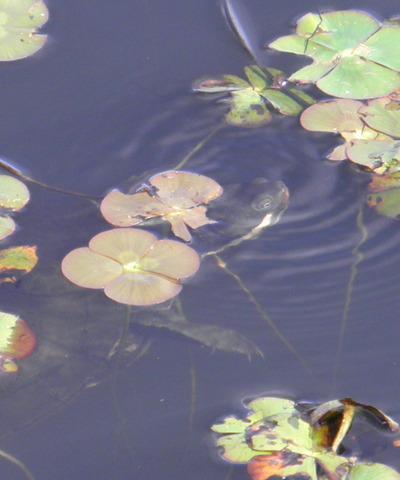
A turtle snout peeping through the Nardoo.
At the dam the turtles were hiding under the Common Nardoo, Marsilea drummondii. They are probably the Eastern Long-necked Turtle, Chelodina longicollis. When you walk onto the jetty you are likely to see a few sticking their nostrils out of the water. The dam is perfect for them as there are safe sunbathing sites and plenty of food. They eat insects, worms, tadpoles and small frogs. 
Christmas beetle, Anoplognathus pallidicollis
In the wildlife garden beyond the rainforest I found this Christmas Beetle. They are not always well-liked by gardeners as they can defoliate vegetation if there are large numbers of them. A member of the scarab family, this golden beauty always reminds me of my childhood.

In the rainforest area is this little delight. You can see how tiny the flowers are by my fingers. The flowers are followed by lovely white berries later in summer. The shrub has luxuriant glossy leaves and loves semi-shade. 
Flowers of Smooth Psychotria,
Psychotria daphnoides
Smooth Psychotria,
Psychotria daphnoides
Another hidden treasure in the rainforest was the Common Brown Butterfly, Heteronympha merope, resting in the dappled foliage. Click here for more on this interesting butterfly. It is difficult to find with its colour and shape such good camouflage.

Fern frond catching the early morning sun.
In the heavy shade of the rainforest floor a ray of sunshine spotlighted a fern frond. It is difficult to believe this area was only planted 6-7 years ago. Already it has some of the characteristics of a much older forest.

The trees in the Brachychiton garden have been flowering for a while now over near the Scott St entrance. These include the Flame Tree, Lacebark, Kurrajong and the delicate cultivar "Gabby's Bells". Look carefully amongst the Flame Tree foliage and you'll find these seed pods. Hidden inside are the seeds ready to burst out. 
Brachychiton cv. “Gabby’s Bells”
 
Flame Tree, Brachychiton acerifolius